
Where Can I Recycle Old Paint Tins in the UK?
Old paint tins accumulate in garages and under stairs across the country, and most people have no idea what to do with them. Pouring paint down the drain is illegal and environmentally damaging. Putting tins in your household recycling bin is not accepted by most councils. And leaving them to dry out indefinitely is not a practical solution either. The good news is that recycling and disposing of old paint tins in the UK is straightforward once you know where to go and what each option accepts.
Household Waste Recycling Centres
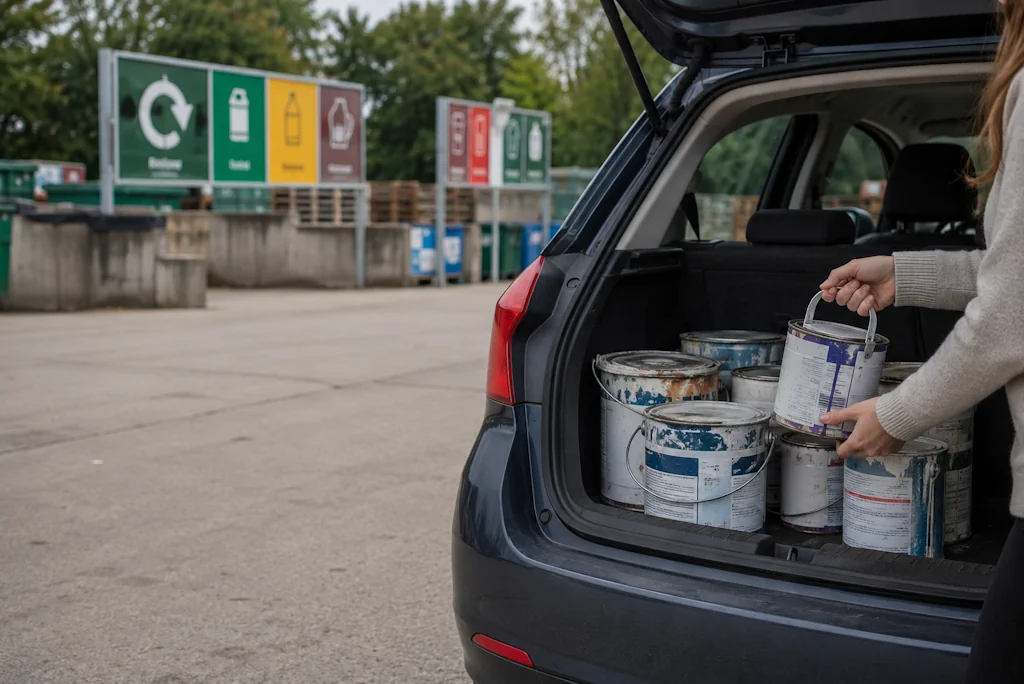
Your local Household Waste Recycling Centre (HWRC), commonly known as the tip or the dump, is the most widely available option for disposing of old paint tins across the UK. Every local authority operates at least one, and most accept both metal and plastic paint containers.
The important distinction is between liquid paint and empty or dried tins. Most HWRCs accept completely empty tins or tins containing fully dried paint in their metal recycling skips without any issue. Tins containing liquid paint fall into a different category. Many centres accept these too, but they go into the hazardous or special waste section rather than the general metal recycling area, and some sites have restrictions on volumes brought in from domestic sources.
Before making a trip, check your local council website or ring the centre directly. Opening hours vary, some sites require advance booking, and a small number of councils have introduced charges for certain waste types in recent years. Searching your postcode on the Recyclemore or Recycle Now websites will locate your nearest HWRC and confirm what materials they currently accept.
Community RePaint Scheme
The Community RePaint scheme is the best option available if your paint is still usable. Run by the national charity Resource Futures and supported by Dulux and several other paint manufacturers, Community RePaint collects leftover paint in good condition and redistributes it to community groups, charities, social enterprises, and individuals who could not otherwise afford it.
This is not a recycling scheme in the traditional sense. It is a redistribution network. Your paint gets used rather than processed, which is the most environmentally responsible outcome of all.
To donate paint through Community RePaint, visit communityrepaint.org.uk and search for your nearest collection point. The network spans hundreds of locations across England, Scotland, Wales, and Northern Ireland, including community centres, DIY stores, and local authority recycling points. Not every area has a collection point, but coverage is broad and continues to grow.
The scheme accepts water-based emulsion paints most readily. These are the standard interior and exterior wall paints that most households use. Some collection points also accept gloss and satinwood paints, though acceptance varies by location. Paint must be in reasonable condition, free from contamination, and still in its original container with the lid intact.
Tin Recycling Through Kerbside Collections
Empty, fully dried paint steel tins are widely recyclable through kerbside collections in the UK, though policies differ between local authorities.
Steel tins are made from one of the most recyclable materials on earth. Steel retains its properties indefinitely through repeated recycling cycles, and the infrastructure for processing it is well established. If your tin is genuinely empty with no residual wet paint, many councils will accept it in your household recycling bin or box alongside food tins and cans.
The key requirement is that the tin must be completely empty and dry. A thin coat of dried paint on the inside is generally acceptable. Any remaining liquid paint disqualifies the tin from kerbside recycling because it contaminates other materials in the collection vehicle.
Remove the lid and recycle it separately alongside the tin. This helps the sorting process at the recycling facility.
Check your specific council’s recycling guidelines because acceptance varies considerably. Some councils explicitly list paint tins as acceptable. Others direct residents to HWRCs instead. Your council’s website will confirm the local position.
Plastic Paint Tins and Containers
Plastic paint containers are a greater recycling challenge than steel tins. The plastic used in most paint pots is polypropylene, or type 5, which many kerbside collections in the UK do not currently accept because processing infrastructure for this material is less widespread than for other plastics.
Empty, clean plastic paint tins should go to your HWRC rather than your household recycling bin unless your council explicitly states otherwise. At the HWRC, they can be sorted into appropriate plastic waste streams for processing.
Some Dulux Decorator Centres and larger trade paint suppliers operate take-back schemes for plastic containers, though these tend to be aimed at trade customers rather than occasional domestic users. It is worth asking at your local trade counter if you have a significant number of plastic containers to dispose of.
Disposing of Liquid Paint: You Cannot Donate
If your paint is no longer usable and you cannot donate it, the priority is to prevent liquid paint from entering your HWRC’s general skip, the drain, or your household bin.
Water-based emulsion paints can be dried out at home before disposal. Open the tin and leave it in a well-ventilated space, outside in dry weather or in a garage with the door open. Stir periodically to accelerate drying. For larger volumes, pour the paint into a cardboard box lined with newspaper or onto sheets of cardboard laid flat in a dry area. The paint soaks into the material and dries far faster than it would in the tin itself. Once fully solid and dry, the hardened material can go into your general waste bin, and the empty tin can be recycled through the appropriate route.
Speedifloc and similar paint hardener products are available from DIY and trade suppliers for a few pounds. Stir the powder into liquid paint; it accelerates the solidification. This is useful when you have multiple tins to deal with and limited time or space for natural drying.
Oil-based paints, gloss, and solvent-based products must never be dried out at home and tipped into general waste. These are classified as hazardous waste. They must go to your HWRC in the hazardous waste section, or to a specialist hazardous waste disposal facility. Contact your local council if you have large volumes of solvent-based paints to dispose of, as they can advise on appropriate routes.
Paint Manufacturers and Retailer Take-Back Schemes
Some paint brands and retailers operate their own take-back or recycling initiatives, though provision in the UK remains patchy compared to several European countries.
Dulux supports the Community RePaint scheme and promotes it actively through its stockists. Several independent paint brands operating in the premium end of the market have introduced take-back programmes for their own containers as part of wider sustainability commitments. Check the website of the specific brand whose paint you need to dispose of, as policies change and improve regularly.
Large DIY retailers, including B&Q and Wickes, have in the past partnered with recycling and donation initiatives at various store locations. Availability varies between branches and over time, so it is worth contacting your nearest store directly rather than assuming the scheme is currently running.
The Legal Position on Paint Disposal
It is worth being clear on what you legally cannot do with unwanted paint in the UK.
Pouring any paint, whether water-based or solvent-based, down a drain, into a garden, or onto land constitutes illegal fly-tipping or environmental pollution under the Environmental Protection Act 1990 and the Water Resources Act 1991. Local authorities and the Environment Agency take paint disposal violations seriously, and prosecutions do occur. The maximum penalty for fly-tipping is an unlimited fine and up to five years imprisonment in serious cases.
Putting tins containing liquid paint into your household bin is also prohibited under most council waste collection contracts. Liquid paint in a refuse collection vehicle creates contamination issues and potential safety hazards.
Dry your paint out, donate usable paint through Community RePaint, take tins to your HWRC, and check your kerbside collection guidelines for empty tins. Those four steps cover every scenario most households encounter.
